
Jules Verne did not predict Apollo 11.
His travelers reach the Moon in a projectile fired from an enormous cannon. Apollo 11 used a Saturn V rocket, a lunar module, mission control, and thousands of people doing specialized work. The difference matters.
Still, From the Earth to the Moon is worth reopening around the July 20 moon-landing anniversary because Verne understood something essential about space travel: getting to the Moon would not be solved by one brave person with a wild idea. It would require calculations, preparation, equipment, and a willingness to admit how much remained unknown.
That is what makes the novel more interesting than a list of supposed predictions.
Verne started with a technical question
In From the Earth to the Moon, members of the Baltimore Gun Club propose sending a projectile to the Moon. The premise is comic and extravagant, but Verne spends a surprising amount of time on constraints: the launch location, the Moon's position, the force required, the design of the vehicle, and the problem of keeping people alive inside it.
His fictional launch must take place between 0 and 28 degrees north or south latitude. That is not Cape Canaveral, but it puts Verne in the same broad geographical logic as later space programs: a launch site near the equator gains an advantage from Earth's rotation.
Verne also sends three travelers. Apollo 11 carried three astronauts: Neil Armstrong, Buzz Aldrin, and Michael Collins. Those similarities are real, but they do not make the novel prophetic. They show a writer thinking carefully about the physical and human problems his story creates.
What Apollo 11 did differently
Apollo 11 launched from Cape Kennedy on July 16, 1969. Four days later, Armstrong and Aldrin separated from Collins in the lunar module Eagle and descended toward the Sea of Tranquility. Collins remained in the command module Columbia, orbiting the Moon alone.
That division of work is one of the clearest differences between Verne's fiction and the real mission. Apollo was not a single projectile carrying its passengers straight to the Moon. It was a sequence of spacecraft, maneuvers, checks, and decisions.
The landing itself was not clean or automatic. During the final descent, Eagle passed a boulder field while computer alarms sounded. Armstrong took manual control and landed with little fuel remaining. The moonwalk that followed is the part most people remember, but it came after years of testing and several tense minutes that could have gone another way.
Apollo 11 returned to Earth on July 24. Verne's original novel ends differently: his travelers are launched into space, while the later sequel follows their journey around the Moon rather than a landing on its surface.
Why the differences make the book better
It is tempting to read old science fiction as a guessing game. What did the author get right? What did the author get wrong?
That can be fun, but it misses the more useful question: What did the author understand about the kind of problem this would be?
Verne understood that reaching the Moon would demand mathematics, engineering, public excitement, money, and collective effort. He also understood that people would argue about the plan long before they agreed on how to attempt it.
Apollo 11 confirmed some of that imagination, then made it more complicated. The mission was not the triumph of one inventor or one astronaut. NASA's account of the landing includes the crew, mission controllers, engineers, technicians, and the systems that had to work together across every phase of the flight.
That is a better story than prediction. It is a story about imagination becoming a problem people can test.
Read Verne with Apollo 11 beside you
Try reading a chapter of From the Earth to the Moon beside a short Apollo 11 mission timeline. Then ask:
- Which details does Verne treat as practical problems rather than decoration?
- Where does the novel rely on nineteenth-century science?
- What did Apollo require that Verne could not have anticipated?
- Why might a real mission need three astronauts with different roles?
- Does the book make space travel feel easier or harder after you compare it with the mission record?
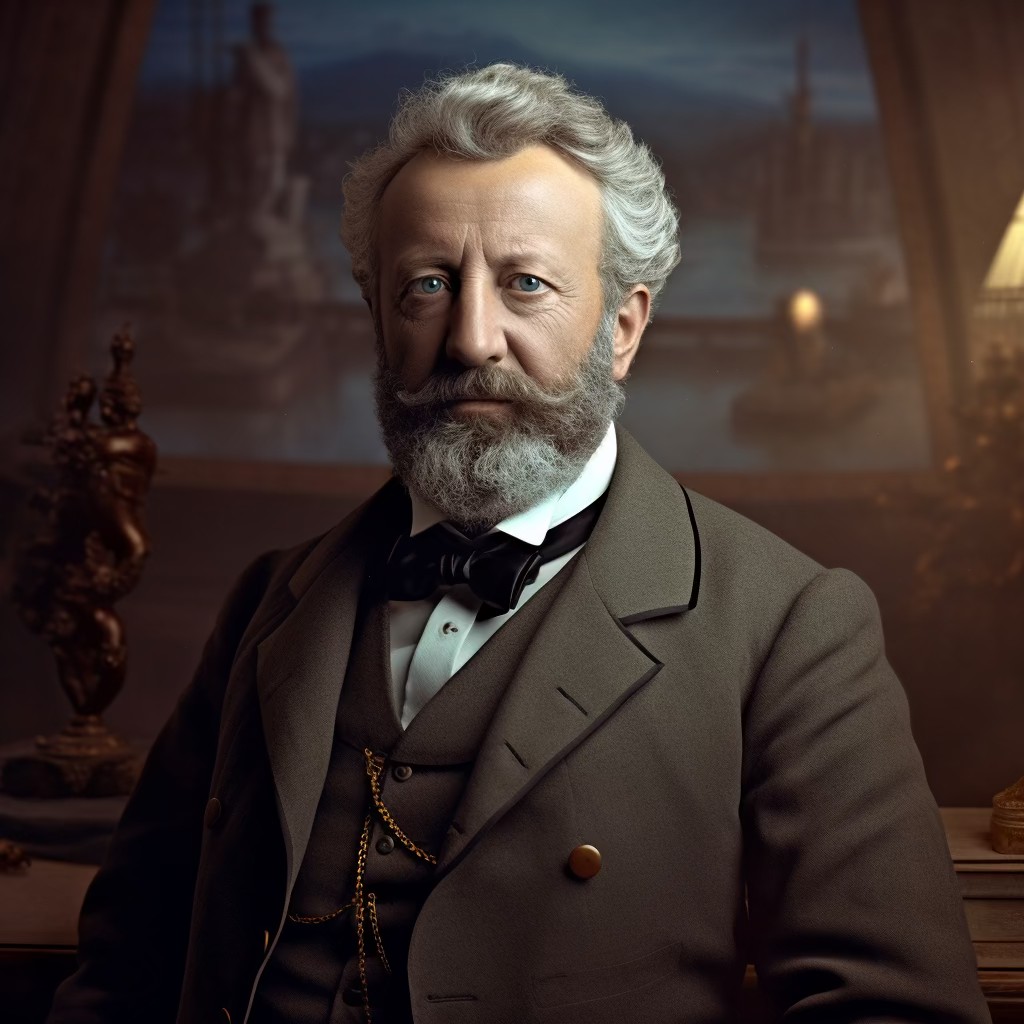
Ask Jules Verne directly in Text With Authors how he approached the novel's launch calculations, three-person crew, and vision of lunar travel. Then return to From the Earth to the Moon and decide which answers the text actually supports.
Verne did not send anyone to the Moon. He did something different: he made readers take the journey seriously enough to ask how it might work.